Preface
In 1904, Sayid Aulad Hasan held several prominent administrative and civic positions in Dhaka, serving as the Special Sub-Registrar, a member of the District Board, a Municipal Commissioner, and a Governor of the Dhaka Hospital. Concurrently, he emerged as a pioneering contributor to the initial phase of the Journal of the Moslem Institute. This publication served as the official organ of the Moslem Institute, a pivotal institution based in Calcutta that catalyzed the intellectual and literary activities of the young Muslim intelligentsia.
That same year, Mr. Hasan published his seminal work, Notes on the Antiquities of Dacca. This volume is widely recognized as arguably the first monograph on Dhaka written in English by a Bengali Muslim. Within this study, Hasan dedicated a specific chapter to Hazrat Shah Ali Baghdadi and his shrines. Notably, this account constitutes the earliest extant English textual record documented on Shah Ali Baghdadi. Consequently, from a historiographical perspective, Hasan’s work stands as a foundational and highly significant historical text for the study of this venerable Sufi saint.
We are presenting this text to our readers primarily for its immense historiographical value as a vital primary source. Through this initiative, we anticipate that further critical historical insights regarding Hazrat Shah Ali Baghdadi will subsequently come to light. To broaden the reach of this scholarship, a Bengali translation of the original inscription will be published by our institution in the near future. This release marks the introductory phase of our broader research initiative dedicated to the life and legacy of Hazrat Shah Ali Baghdadi, a project that we remain firmly committed to continuing in successive stages.
***
HAZRAT SHAH ALI SAHIB’S Dargah (Mausoleum) at Mirpur
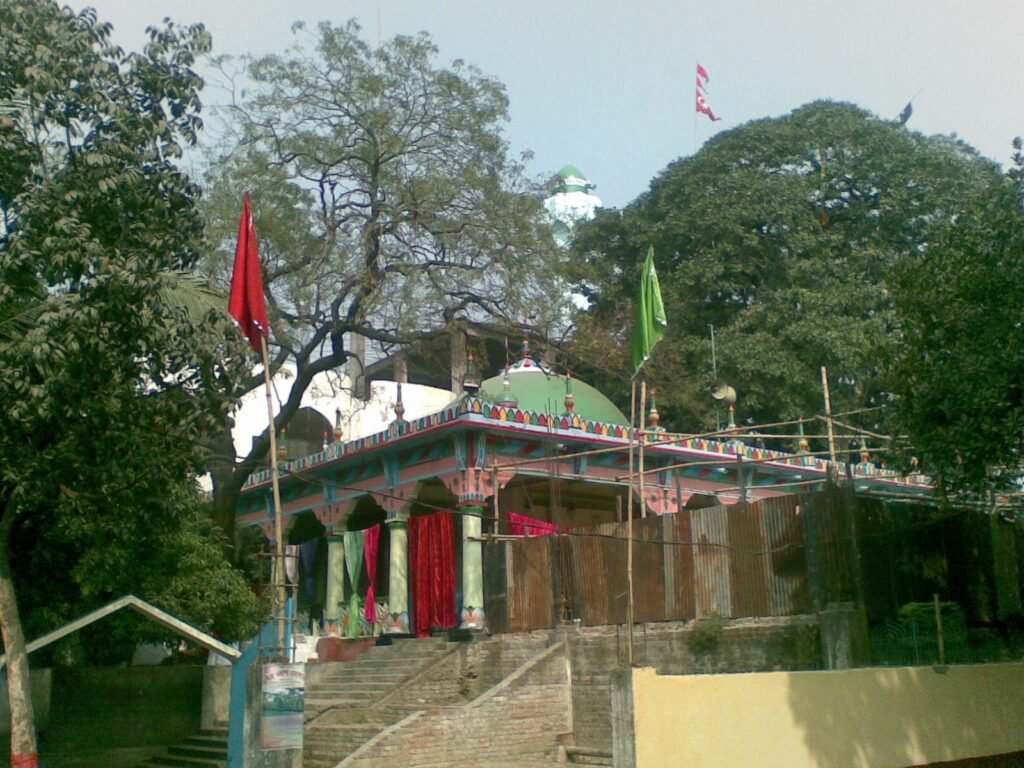
About eight miles to the north-west of the city, near the village of Mirpur, stands the famous mausoleum of Hazrat Shah Ali Baghdadi. It is a square building 36 ft. outside measurement and is surmounted with a large dome. The walls are 7 ft. thick. Hazrat Shah Ali was one of the forty missionaries who came out to India from Baghdad in the ninth and tenth centuries of the Hijri to spread the Mahomedan religion, and to teach the Mahomedans then living in the country, morality and the better observance of their religion. He came to Mirpur and lived in the mosque in which he has been interred. Tradition says that the Hazrat was a Prince of Baghdad. Having renounced the world, he came to Mirpur, accompanied by four disciples, and lived in the mosque in when he lies buried. Sometime after his arrival, for the performance of a penance, and for religious meditation, he shut himself up in the mosque, desiring his disciples not to open the door, or otherwise disturb him for forty days. Thirty nine days passed, and when only one day remained, the disciples heard a noise inside, as if of some liquid substance boiling. Becoming anxious they forced the door open, when they found nought of the saint remaining except a pool of boiling blood in the centre of the mosque. An aerial voice, resembling that of the saint, desired them to inter the blood where it lay. This they did.
It appears from the inscription on the mausoleum reproduced below, that the mosque was built in 885 H. (A. D. 1480) But by whom, it is not stated. Yusuf Shah was then the King of Bengal, and Gaur was the capital of the kingdom. Shah Ali Sahib died in 985 H. (A. D. 1577) and was buried in it. The mausoleum being in a very dilapidated state, during the Naib-Nizamat of Nawab Nusrat Jang, the late Shah Muhammadi Sahib of Magbazar, a very pious man, respected as a saint, had it thoroughly repaired. The outhouses were built some years ago by the late Nawab Sir Ahsanullah Bahadur, who also looked after the repairs of the mausoleum. As a saint Shah Ali Sahib is in great repute in this part of the country. His tomb is annually visited by thousands of people from different parts of Eastern Bengal.
Copy of the inscription.
این خاک چو شد نخست مسجود
سال هجري ان ضفه بود
در سال ظفه زدور گردون ۹۸۰
شد بار دگر خرابي الود
پس شاه علي زارض بغداد
تشریف بخاک هند فرمود
بنشست در و و بست در را
بر خود ره خلق کرده مسدود
تا انکه جهان فاني را
ان و اصل حق نمرده پدرود
کردند بنو عمارت ها و را
شد مرقدش مقام محمود
شد با ز بها را و خزان را
از گردش چرخ دست فرسود
اکنون بعهد نصير ملك نواب
غر کا سن هجري است معدود ۱۲۲۱
تعمیر سیرم محمد شاه
تو بعين خلوص قلب نمود
ها تف گفتا که يا الهي
همسایه یرد ز ظل ممدود
سال ۱۲۲۱
Sanetified first was this ground in Hijree M minus C minus X minus V
In M minus XV by fortune’s fell spite
Demolished it was and overthrown quite But when great Shah Ali to India did come
From the town of Bughdad which was his own home
He dwelt on this spot and barred every door
That the visits of mortals might trouble him no more
And lo! that God-seeker to this world of decay
Bade good-bye for ever and farewell for eye
Then ’twas rebuilt by the men of the town
And the place of his rest was a place of renown
Then changed was its spring into autumn once more
By the wrath of the sky which rolleth e’ermore
In Nasirul-Mulk’s time again it rose high In M plus two C’s plus two X’s and I
The third rebuilding on it ye should know Muhammadi Shah’s piety of soul did bestow
A speaker unseen “God May thou” did say
“Cover it Completely With thy shadow I pray”
MCCXXI-1221
(Translation by Harinath De.)