Preface
To date, three epigraphic records have been discovered within the mosque and adjacent architectural structures of the shrine (Dargah) of Hazrat Shah Jalal. Among these, two inscriptions date back to the reign of Sultan Alauddin Husain Shah (one from 1505 CE and the other from 1512 CE), while the third belongs to the era of Sultan Abul Muzaffar Yusuf Shah. Shamsud-Din Ahmed, a pioneer of epigraphy in Bangladesh, compiled these three inscriptions, provided their English translations, and offered critical analytical discourse on the subject. For the benefit of readers and researchers alike, this section has been reproduced from his seminal work, Inscriptions of Bengal (Volume IV), published by the Varendra Research Museum, Rajshahi, in 1960.
These three inscriptions are considered the most authentic primary source materials regarding Hazrat Shah Jalal’s conquest of Sylhet and his biographical details. The historical controversies surrounding the saint can be systematically resolved if analyzed through the lens of these epigraphs. Although several scholars have previously worked on Hazrat Shah Jalal, these three inscriptions have not yet been granted due scholarly evaluation. We firmly believe that if future researchers critically incorporate these epigraphic records, many long-standing debates regarding Hazrat Shah Jalal and the contemporary history of the region will be successfully put to rest. We reproduce this critical documentation here for the convenience of general readers and researchers interested in Hazrat Shah Jalal and the history of medieval Bengal.
***
First Inscription
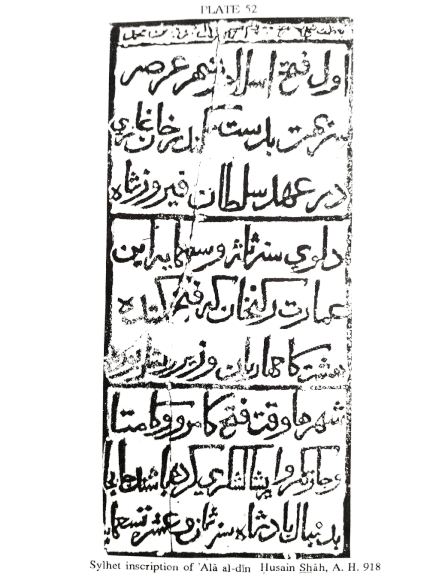
The language of the inscription is Persian and the script Naskh of a simple type.
Text:
بعظمت شيخ المشايخ مخدوم شيخ جلال مجرد بن محمد
First Panel
الأولى الفتح الإسلامي الأول شهر عرصه
سريحت بدست سكندر خان غازي
.در عهد السلطان فيروز شا
Second Panel
دلوي سنة الثلث والسبعماية اين
عمارت ركن خان كه فتح كننده
.هثت كامها ريان وزير ولشكر بوده
Third Panel
شهرها وقت فتح كامرو وكامتا
وجا جنكر واريشا لشكري كرده باشند جابجا
.بدنبال بادشاه سنه ثمان وعشر تسعماية
TRANSLATION
Top
In honour of the exalted Shaikh-ul-mashaikh, revered Shaikh Jalal, the ascetic, son of Muhammad.
First panel
The first conquest by Islam of the town of ‘Arsah Srihat was in the hand of Sikandar Khan Ghazi in the time of Sultan Firoz Shah.
Second panel
Delavi (Dehlavi) in the year 703 A.H. (1303 A.C.). This building (has been erected by) Rukn-Khan, the conqueror of Hasht Gamarian, who being wazir and general.
Third panel
For many months, at the time of the conquest of Kamru, Kamta, Jaj-nagar and Urisha, served in the army in several places in the train of the king. Written in the year 918 A.H. (1512 А.С.).
The inscription was first discoverd by H.E. Stapleton and noticed in the Dacca Review in August, 1913, and subsequently the text, translation and a photo-plate of it was published in J.A.S.B., (New series), Vol. XVIII, 1922, pp. 413-14, Pl. IX.
The stone-tablet bearing the inscription must have been found in Sylhet, but Stapleton is silent about it. The epigraph is now displayed in the gallery of the Dacca Museum.
The epigraph is inscribed on an oblong slab of stone, the carved surface of which is divided into three panels, each containing three lines of wirting in raised letters, with a line in small letters at the top. Though not a contemporaneous record, it refers to the conquest of Sylhet in the year 703 A.H. by Sikandar Khan Ghazi, during the reign of Firoz Shah Delwi (sic). Stapleton asserts, on the strength of this inscription, that it is practically certain that the conquest of Sylhet took place in the time of Shamsud-Din Firoz Shah.
There is a tradition among the local people that a Muslim subject of the Hindu Raja Gour Govinda of Sylhet had killed a cow to celebarte a certain festival in honour of the birth of his son. On receiving this information, the Raja flew into a rage and ordered to slay the son. The father being extremely mortified, appealed to the court of Firoz Shah who immediately sent an army under Sikandar Ghazi against the Raja. When the general failed at first to defeat Gour Govinda, he was reinforced by detachment under Sayyid Nasirud-Din Sipahsalar, accompanied by Shah Jalal and other warrior saints, who routed the Raja and brought the country under Muslim rule. A similar tradition is associated with the conquest of the Hindu territory of Satgoan in West Bengal. In this case, Sultan Firoz Shah sent an army commanded by Zafar Khan and his nephew Sufi Khan against the Hindu Raja, Bhoodev Nripatı. A battle was fought at a place called Mahanad, near Satgoan, about 8 miles west of Tribeni in the Hoogly district, in which Zafar Khan’s army was victorious.
Some discrepancies are observed in this record; firstly the epithet of (دلوی) Delvi, if it means (دھلوی Dehlavi) does not seem to have been ever used in any document of this nature, by any Sultan of Delhi; secondly neither Jalalud-Din Firoz II, of the Khalji House nor Firoz Shah III Tughlaq was on the throne of Delhi in 703 A. H., as mentioned in the epigraph.
Stapleton identifies this ‘Firoz Shah Delvi’ with Shamsud-Din Firoz Shah, who was ruler of Bengal from 701 to 722 A. H. (1301-22 A. C.) and contends that:
(1) Sultan Firoz Shah was actually on the throne of Bengal in 703 A. Н.
(2) As the grandson of Ghiyathud-Din Balban, he is rightly called Dehlavi (cf. also the connection of Firoz Shah with Dehli in the Satgaon tradition).
(3) The date is in agreement with a local tradition that when Sikandar Ghazi at first failed to defeat Raja Gour Govinda, Sayyid Nasirud-Din Sipahsalar, accom-panied by Shah Jalal and other warrior saints, came to assist him and that the former was a General of Firoz Shah Dehlavi.
(4) A village of the name Sekandar-nagar, in south-eastren Mymensingh may possibly owe its name to Sikandar Ghazi, but he is apparently buried at Bishgaun (alias Ghazipur) in the extreme south-east of the Habiganj sub-division of Sylhet district, where his shrine is venerated by Muslims and Hindus alike. Before coming to Sylhet, he is said to have warred successfully against a Hindu Raja of the Sundar-bans, called Matuk.
As regards the probable cause of the invasion of Sylhet, Stapleton has advanced a theory based on the narration of Barani and says that Jalalud-Din Firoz Shah Khalji despatched boat-loads of undesirables to the lower country in the negihbourhood of Lakhnauti where they were “set free as not to trouble the neighbourhood of Delhi any longer.”! The easiest way for the Sultans of Bengal to nullify such a wholesale deportation (nearly 1000 came in one lot) was to enrol these men in a “Foreign Legion” and utilize them in warring against the infidels on the frontiers of Bengal, and this was probably what Shamsud-Din and his predecessors actually did.
Rukn Khan, mentioned in the inscription was a well-known General of Sultan Husain Shah of Bengal. His name occurs in two other inscriptions treated by Blochmann in J.A.S.B. 1870, pp. 284 and 295, and J.A S.B., 1872, p. 106. He was the hero of the campaign for the conquest of Kamrup, Kamta, Jajnagar and Orissa. Blochmann wrongly asserts that Rukn Khan was an inhabitant of Sarhat in Birbhum instead of Sylhet.
Second Inscription
The style of writing is Naskh and the language is Arabic.
TEXT
… ابو المظفر یوسف شاه ابن باریک شاه السلطان ابن محمود شاه السلطان خلد الله ملكه وسلطانه – و بانى هذا المسجد المجلس الاعظم المعظم الدستور الساعي في الخيرات و المبرات المجلس الاعلى حفظه الله تعالى عن الدفات…
TRANSLATION
Abul Muzaffar Yusuf Shah, son of Barbak Shah, the Sultan, son of Mahmud Shah, the sultan, may Allah perpetuate his rule and kingdom. And the builder of this mosque is the great and the exalted Majlis, the wazir (Dastur) who exerts himself in good deeds and pious acts the exalted (اعلى) Majlis may Allah the Great preserve him against the evils.
Dr. Wise seems to have discovered this epigraph too and taking an estampage of it sent the same to H. Blochmann for decipherment. The former, while for-warding the rubbing remarked, “The inscription is from one of the four mosques which surrounded the tomb of Shah Jalal at Sylhet. It is a fine Tughra inscription, but unfortunately one-third of it has been built into the masonry, the slab forming the lintel of the door.” A considerable portion in the beginning as well as from the end of the inscription containing the prelude and the chronogram respectively is missing on account of peculiar setting of the slab in the mosque as stated above.
The text and translation of the epigraph have been published by H. Blochmann in the J. A. S. B., Vol. XLII, 1873, pp. 277-81.
The record refers to the erection of a mosque during the reign of Yusuf Shah, but the name of the author of this charitable work and its date have yet to be brought to light by further researches.
Judging from the estampage of the inscription, Dr Wise is of opinion that this record ranges as one of the finest specimens of its kind and can be placed immediately next in point of beauty and elegance to the inscription of Sikandar Shah No. 8.
Dr. Wise has forwarded an interesting note on the life and working of Shah Jalal, the patron saint of Sylhet a summary of which is being reproduced below. It may be mentioned here that the note is taken from Suhail-i-Yaman, written by Nasirud-Din, late Munsif of Sylhet, composed in the year 1859. This work has, however, an abstract and abridgement of two earlier works, one of which is called the “Risalah of Muhuud-Din Khadim” and the other “Rauzatus-Salatin”, by an unknown author.
Nasirud-Din, the author of “Suhail-i-Yaman” according to Dr. Wise. states that Shah Jalal, the Mujarrad (Bachelor) was the son of Muhammad, a distinguished saint, whose title was Shaikhush-shuyukh and who traced his descent from the Quraish tribe. His mother was a Sayyidah who died within three months of the birth of this, her only son, while his father laid down his life in a Jihad, fighting against the infidels. The youth was reared up by his maternal uncle Sayyid Ahmad Kabir Suhrawardi, an accomplished divine who was a disciple of the renowned Shah-Jalalud-Din Bukhari.
Shah Jalal is said to have passed in devotion in a cave for thirty years when he was called from his seclusion in a peculiar circumstance. One day Sayyid Ahmad, while sitting in front of his house at Mecca, in deep contemplation, saw a doe, big with young, approaching him. The doe related that a lion had appeared in the wood in which she lived and was killing all her comrades there and requested him to go with her and drive away the brute. Sayyid Ahmad called forth Shah Jalal from his cave and directed him to accompany the doc and turn out the lion. The latter, however, had some misgiving in his mind but in reaching the jungle he unexpectedly met the animal and the luster which shot from his eye was so dazzling that the lion fled and was heard of no more.
On his return from the mission, his uncle was so pleased with the nephew on his achievement, that he gave Shah Jalal a handful of earth and charged him to go forth and wander over the world till he found earth of similar color and odor and to settle down there.
He accordingly started on his journey and while passing by a city of Yaman, the chief of the country got information that a great saint was approaching. At this, he sent a cup of deadly poison to test his divine power Shah Jalal at once divined its nature, and informed the chief’s messenger that the moment the draught was swallowed, the king would die. The poison was quaffed with-out injury to the saint, but, as aforesaid, the chief died.
Shah Jalal proceeded on his course, but after four days the son of the chief overtook the saint in his wonderings, leaving his paternal state.
Next they arrived at Delhi where the celebrated Nizamud-Din Aulia then resided. The latter at once became conscious of the arrival of a saint and sent a messenger to search and invite him to dine with him. Shah Jalal accepted the invitation and gave the messenger a bottle filled with cotton, in the center of which he placed a live coal. The receipt of this wonderful present so convinced Nizamud-Din that this was no common saint and he was treated with great honor. At his departure Nizamud-Din gave him a pair of black pigeons.
As Shah Jalal proceeded further on his itineracy, the number of his disciples swelled up to 300 persons with whom he reached Sylhet and started preaching Islam. Here at that time a war was being waged against the Muslims by the local king, Gaur Govinda. The incident leading to this war is stated as under:
One Shaikh Burhanud-Din resided at that time in a Mahalla called Tol-Takar in the town of Sylhet. He once sacrificed a cow to celebrate the birth of his son and per chance a kite carried off a piece of the flesh and dropped it in the house of a Brahmin. This was taken as an act of sacrilege and the incensed Brahmin lodged a complaint with Gaur Govinda, the king of Sylhet. The king sent for Burhan who confessing to have killed a cow, the child was ordered to be put to death and the right hand of the father cut off.
Sorely aggrieved, Burhanud-Din left Sylhet and approached the court of Gaur, praying for a redress, The Sultan, on hearing the pathetic incident, ordered his nephew prince Sikander to march at once with an army. Gaur Govinda was a powerful magician. On hearing the approach of an army of the Muslim king.
He assembled a host of devils and put them to flight together with prince Sikandar and Burhanud-Din. The prince reported his discomfiture to his uncle, the Sultan who dispatched Nasirud-Din Sipahsalar with a force to the assistance of Sikandar. Even the joining of the two forces did not restore the courage to the Muslim soldiery and it was decided to consult Shah Jalal who was at that time waging war with the contingent of his 360 adherents Darvishes, on his own account. against the infidees. Shah Jalal agreed to fight and the advance of this army of saints was so irresistible that the devils could not prevail against them. Gaur Govinda was driven from one position to another and at last he sought refuge in a seven storied temple in Sylhet, which had been built by magic. The invaders encompassed the temple and Shah Jalal prayed all day long. His prayer was so effective that each day one of the stories fell down and on the fourth day. Gaur Govinda yielded on the promise of being allowed to leave the country. The terms were agreed to and Gaur Govinda retired to the mountains.
While at his protracted prayers, Shah Jalal discovered that the earth on which he was kneeling was of the same color and smell as that given him by the saint at Mecca. He thereupon built his abode and established himself there with the ‘Shah-Zadah’, the prince of Yaman who ever remained with the saint. The remainder of Shah Jalal’s life was spent in deep devotion. The saint is said to have passed away on the 20th of the ‘Kalichand’, 591 A. H in the 62nd year of his age.
There is a great confusion in the chronology and names in the above narration and in this connection, Blochmann observes as follows: “The chronology of the ‘life of Shah Jalal’ as Dr. Wise observes, is confused. His death is put down as having occurred in 591 A. H., and he is said to have visited Nizamud-Din Aulia, who died in 725 A. H. Again according to the legends still preserved in Sylhet, the district was wrested from Gaur Govinda, the last king of Sylhet., by ‘king Shamsud-Din’ in 1384 A.C or 786 A. H., during the reign of Sikandar Shah, whilst ‘king Shamusd-Din’ can only refer to Shamsud-Din Ilyas Shah, Sikandar’s father.”
Third Inscription
Dr. Wise is credited with having traced this epigraph. He sent a rubbing of it to H. Blochmann through the Asiatic Society of Bengal for study. Though the record is reported to have been found in Sylhet, the exact locality or place where it was found is not mentioned by him.
The epigraph records the construction of a building under orders from the saint Shaikh Jalal, during the reign of Husain Shah by one Khalis Khan in the year 911 Α. Η. (1505 А.С.).
It was deciphered and published by Blochmann in the J.A.S.B., Vol. XLII, 1873 pp. 293-94 with a translation.
The language is Arabic mixed with Persian, but Blochmann is silent on the style of writing, which must be Naskh.
TEXT
بسم الله الرحمن الرحيم – الامر لهذه العمارة البقعة المباركة المنصوبة بدار اللحسان – حرمه الله تعالى من مخافة الزمان – العابد العالى الكبير شيخ جلال مجرد کنیایی قدس الله سره العزيز – في عهد السلطان علاؤ الدنيا و الدين ابو المظفر حسين شاه السلطان – خلد ملکه و سلطانه – بنا کرد خاناعظم خالصخان – جامدار غیر محلی و سر لشکر و وزیر اقلیم معظما باد – سنة احدى عشر و تسعماية .
TRANSLATION
In the name of Allah, the Merciful, the Clement! He, who ordered the erection of this building, in the blessed spot assigned as ‘Darul-Ihsan’, ‘the house of benefit’ (Sylhet) may Allah the Most High protect it against the ravages of time, is the devotee, the high, the great… Shaikh Jalal, the celibate, of Kanya, may Allah the Exalted sanctify his dear secret! It was built in the reign of the sultan, Alaud-Dunya wad-Din Abul Muzaffar Husain Shah, the sultan, by the great Khan, the exalted Khaqan, Khalis Khan, Keeper of the ward-robe outside the palace, commander and wazir of the district of Muazzamabad in the year nine hundred and eleven 911 Α. Η. (1505 А. С. ).
A short note on the life and work of Shah Jalal, the saint patron of Sylhet is given above in connection with inscription No. IX of Yusuf Shah. Shah Jalal is supposed to have died about 786 A. H. or 1384 A. C.
The building in question was ordered, according to the present inscription, to be erected by Husain Shah, under order from Shah Jalal in 911 A. H. This statement gives rise to a confusion as the saint was dead long ago. It is therefore surmised that Husain Shah received the order in a dream, as was also the case with Ali Shah and the saint Jalal Tabrizi.
As regards Iqlim Muazzamabad, Blochmann remarks, “North-western Sylhet had the name of Laud or Laur, and the thana which the Muhammadans established there was under the commander of the ‘Iqlim Muazzamabad’, or ‘the territory of Muazza-mabad’, also called ‘Mahmudabad’. The exact extent of Muazzamabad is still unknown, but the name occurs on coins and on Sunargaon inscriptions, once in conjunction with Laur, and once with Tiparah, and it seems, therefore, as if the ‘Iqlim’ extended from the Megna to north-eastern Maimansingh and the right bank of the Surma. In the ‘Ain’ we find, indeed, under Sirkar Sunargaon, a Mahall Muazzampur, the chief town of which lies between the Brahmaputra and the Lakhia and bears the same name.” ( J.A.S.B., Vol. XLII, 1873, pp. 235-36)
Inscriptions of Bengal (Volume IV): Shamsud-Din Ahmed, Varendra Research Museum, Rajshahi, 1960, 24-5, 109-112, 169-70 pages.