Preface
Shaikh Akhi Siraj was an eminent fourteenth-century Sufi saint and scholar. His Dargah complex is situated in Gaur, the historical capital of contemporary Bengal. A comprehensive scholarly discourse regarding his shrine and ancient inscriptions was produced by Khan Sahib Abid Ali Khan, the renowned historian and citizen of Maldah.
We are republishing his insightful analysis here, supplemented with an academic note by the British IES officer, Henry Ernest Stapleton.
***
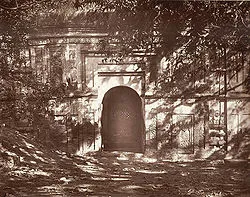
The tomb of this saint who is locally referred to either as Purana Pir (the Old Saint), or Piran-i-pir (Saint of Saints) is situated at the north-west corner of the Sagar Dighi. It is remarkable for the three very elegant embrasures of the old enclosure wall that immediately surrounds the actual building that covers the tomb itself. Those to the east and west are 7.2/1 feet deep while that to the north—opposite the entrance gate—measures 6 feet in depth. The pierced and decorated brickwork that closed the eastern embrasure has now disappeared, and that on the west is greatly damaged. It is only on the north that the brickwork remains more or less in its original condition.
The enclosure wall with its gate, as well as the simple masonry building over the grave of the Saint, has been repaired of recent years (about 1900), and the only inscriptions now found at the place are fixed, two to the left and two to the right of the doorway of the building that contains the Saint’s tomb.
One of each of these inscriptions simply bears an inscription from the Quran.
The other two run as follows :
Left-hand Inscription:
قد بنى هذا الباب المررضة مخدوم شیخ اخى سراج الدين السلطان المعظم المكرم علاؤ الدنيا و الدين ابو المظفر حسين شاه السلطان بن سيد اشرف الحسيني خلد الله ملکه و سلطانه سنة ست عشر و تسعمائة.
Translation: “Verily this gateway of the tomb of the revered Shaikh Akhi Sirajuddin was built by the Exalted and Liberal Sultan Alaudduniya waddin Abul Muzaffar Husain Shah, the Sultan, son of Saiyid Ashraf al-Husaini- May Allah perpetuate his Kingdom and Rule!-in the year 916 Α.Η.” (1510 A.D.)
Right-hand Inscription:
بنى هذا الباب للروضة بامر السلطان المعظم الكرم سلطان بن السلطان ناصر الدنيا و الدین ابو المظفر نصر تشاه السلطان بن حسین شاه السلطان خلد الله ملكه في سنة احدى و ثلثين وتسعمائة.
Translation: “This gateway of the tomb was built by the order of the Exalted and Liberal Sultan, the Sultan, son of the Sultan, Nasirudduniya waddin Abul Muzaffar Nusrat Shah, the Sultan, son of Husain Shah, the Sultan- May Allah perpetuate his Kingdom! in the year 931 Α.Η.” (1524-25 A.D.)
A third inscription of 916 A.H.-mentioned by General Cunningham— which recorded the erection of yet another gateway, has now apparently disappeared but a fourth inscription from this site, recording the erection of a shed for supplying drinking water, has been taken to English Bazar and placed over the gate of a recently erected Mosque.
As General Cunningham rightly inferred from the dates of the first inscription the tomb was already in existence in the time of Husain Shah. This is also certain from the account of Shaikh Akhi Sirajuddin found in literature dealing with the lives of Musalman Saints. Blochmann (J. A. S. B., 1873, p. 260) says that he “came as a boy to Nizamuddin Auliya of Delhi, who handed him over to Fakhruddin Zarradi [died 748 A.H.-1347 A.D.] to teach. In course of time he became very learned and was told to go to Bengal where he died in 758 A.H. or 1357 A.D. The Haft Iqlim says that Nizam called him ‘the mirror of Hindusthan’ and that he only received, when advanced in age, proper instruction from Fakhruddin. After Nizam’s death [in 725 A.H.-1325 A.D.], he went to Lakhnauti, and all the Kings of Bengal became his pupils”. According, however, to the Khurshid-i-Jahan Numa of Munshi Ilahi Bakhsh, he died on 1st Shawwal, 743 A.H. (1342 A.D.). The chronogram of his death is (زود گو کان روز عيد الفطر بود – Say quickly It was Idul-Fitr Day) A probable, reason for his asking to be sent to Gaur was that his mother lived there, but he was originally from Oude.
According to Firishta (Bombay edition, Vol. II, p. 737), Akhi Sirajuddin was the grand-father of Shaikh Nur Qutbul Alam of Pandua, but this is a mistake. He can only be called the spiritual grand-father of Nur Qutbul Alam, as the latter’s father, Shaikh Alaul Haqq, was a pupil of Akhi Sirajuddin. The anniversary of the death of the Saint is celebrated at the great Sagar Dighi on Idul-Fitr day annually, when the heraldic symbol (jhanda) of Makhdum Jahaniyan Jahangasht and the Panja (reproduction of the hand) of Shaikh Nur Qutbul Alam are sent here from Pandua as a mark of respect to the saint. A great mela (fair) is also held every year on both the Idul-Fitr and the Bakr Id days.
It is said by the local mawlawis that the articles of every day use, such as Qur’an, Tasbih (rosary), Rihal (book-stand), etc., of the Saint have also been buried at the head of the grave, and that this accounts for the abnormal length of the grave.
***
A Note by Henry Ernest Stapleton
The late Khan Sahib has omitted to refer to a very important inscription on some bricks now in the Indian Museum which General Cunningham argued came from a panel of about the same total size that was still visible in 1879 over the main gateway of the tomb of Akhi Sirajuddin. Cunningham read the last word on the fourth brick to be Saba’mi’atin (700), and hence concluded that the King, Ghiyasuddin, mentioned on one of the other bricks was A’zam Shah (the son of Sikandar Shah) who reigned as sole king of Bengal from A.H. 792 to 813. The word looks however more like tisa’ mi’atin (900) in which case the King who put up the inscription was Ghiyasuddin Mahmud Shah (the son of Husain Shah) who reigned from A.H. 939 to 944. The importance of this inscription is not so much in regard to the King’s name, but the place name of Shahr Muhammadabad clearly given on the last brick. If Cunningham was right in assigning this inscription to the gateway of Akhi Sirajuddin’s tomb, this gives us in all probability the local name of this part of Gaur. It is hardly likely that the name could have been derived from Jalaluddin Muhammad (the son of Raja Kans A.H. 818) as all associations of this King were with Pandua. As there is no other King of this name among the Kings of Bengal, it appears highly probable that the name was derived from that of Muhammad Tughlaq of Delhi who, after conquering and slaying Sultan Ghiyasuddin Bahadur of Bengal about the year A.H. 728 (A.D. 1328), included for a short time Bengal within his dominions. From the existence of the Sagar Dighi it is probable that the headquarters of the Hindu Kings who excavated this enor-mous tank were in its immediate vicinity, and it would be only natural if the early Muhammadan Governors and Kings of Bengal (including Qadar Khan, the Governor appointed by Muhammad Tughlaq) continued to use the vicinity of the Sagar Dighi as their head-quarters. The soundness of the argument depends to some extent on whether or not Cunningham was correct in assigning the inscription to the shrine of Akht Sirajuddin, but the fact that Akhi Sirajuddin was buried at this spot about the middle of the 14th century suggests that at this time the place was still of some importance. In any case the theory just given offers some explanation of the previously unexplained name Muhammadabad, which is found as a Mint name on several coins issued between A.H. 880 (?) and 913.
(Memoirs of Gaur and Pandua: Khan Sahib M. Abid Ali Khan, Bengal Secretariat Book depot, Calcutta, 1930, 90-92)