Preface
At the Dargah (shrine) of Hazrat Shah Ali Baghdadi, a mosque was commissioned by Sultan Shamsuddin Yusuf Shah in 885 AH / 1480 CE. Contextualizing this construction, the renowned scholar Dr. Enamul Haque observes that “almost all the mosques adjoining to the ‘Dargahs’ in Bengal, were built after the death of the saints or during their life time.”
The foundation inscription of this mosque was originally discovered by Dr. James Wise in 1783 and subsequently published by H. Blochmann in the Journal of the Asiatic Society of Bengal (JASB) in 1875. A critical commentary on this epigraphic record was provided by Dr. Abdul Karim, the pioneering historian of Bangladesh, in his monumental corpus, Corpus of the Arabic and Persian Inscriptions of Bengal, published by the Asiatic Society of Bangladesh in 1992.
***
Inscription from Mirpur, Dhaka
Dr. James Wise discovered this inscription somewhere in the neighborhood of Dhaka and procured an estampage and forwarded it to H. Blochmann who published it in the JASB, vol. XLIV, 1875. Blochmann missed the exact find-spot of the epigraph, so he could not mention it. But I think that the epigraph belongs to the mosque at Mirpur, wherein the famous saint Shah Ali Baghdadi has been lying buried. Even now there is an epigraph fixed over the main entrance of the mosque (now tomb of Shah Ali Baghdadi), but it is built in in such a way that it is not possible either to take a photograph or an estampage. There is a modern epigraph dated 1221 A.H. (1806-07 A.D.), according to which the mosque (now tomb) was built in 885 A.H. (1480-81 A.D.).[1]
About Shah Ali Baghdadi and how he was buried in the mosque, Sayid Aulad Hasan writes as follows: “About eight miles to the north-west of the city, near the village of Mirpur, stands the famous mausoleum of Hazrat Shah Ali Baghdadi. It is a square building 36 ft. outside measurement and is surmounted with a large dome. The walls are 7 ft. thick. Hazrat Shah Ali was one of the forty missionaries who came out to India from Baghdad in ninth and tenth centuries of the Hijri to spread the Muhammadan religion and to teach the Mohammadans then living in the country, morality and the better observance of their religion. He came to Mirpur and lived in the mosque in which he has been interred. Tradition says that the Hazrat was a prince of Baghdad. Having renounced the world, he came to Mirpur, accompanied by four disciples, and lived in the mosque in which he lies buried. Sometime after his arrival, for the performance of a penance, and for religious meditation, he shut himself up in the mosque, desiring his disciples not to open the door, or otherwise disturb him for forty days. Thirty nine days passed, and when only one day remained, the disciples heard a noise inside, as if of some liquid substance boiling. Becoming anxious they forced the door open, when they found nought the saint remaining except a pool of boiling blood in the centre of the mosque. An aerial voice, resembling that of the saint, desired them to inter the blood where it lay. This they did.”[2]
The architectural style shows that the small mosque was originally built in the pre-Mughal period.[3] The mosque (later tomb) was for long in a ruinous condition; in the early 19th century it was repaired and renovated by Shah Muhammadi Sahib of Magh Bazar, Dhaka, who also put up a Persian inscription, in which the date of the first construction of the mosque (885 A.H.) is given. It seems, therefore, that an estampage of the inscription of this mosque was forwarded by James Wise to H. Blochmann.
Reference:
1) Blochmann, JASB, vol. XLIV, 1875, pp. 293-94.
2) A.H. Dani, Muslim Architecture in Bengal, p. 32, no. 51.
3) S. Ahmad, Inscription of Bengal, pp. 108-109.
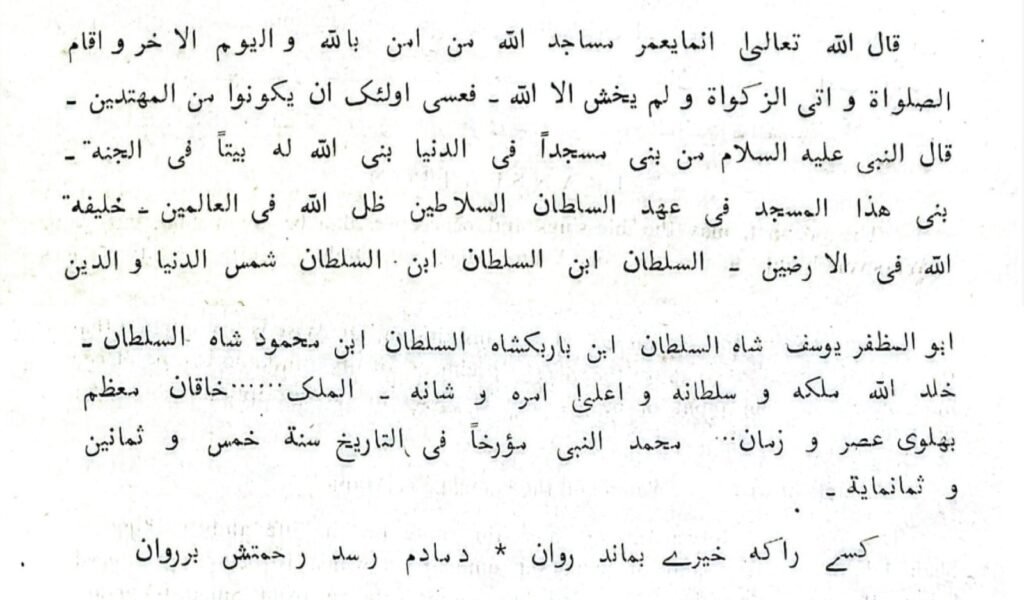
The inscription consists of three lines of writing and is inscribed on a stone slab measuring 2′-8 inches by 10 inches. The record refers to the construction of a mosque in 885 Α. H. in the reign of Sultan Shams al-din Yusuf Shah. The language is Arabic, but at the end there is a Persian couplet from Shaikh Sadi’s Bustan. The style of writing is Naskh.
The epigraph as read by H. Blochmann is as follows:
Text
قال الله تعالى انما يعمر مساجد الله من آمن بالله واليوم الآخر واقام الصلواة واتى الزكواة ولم يخش الا الله – فعسى أولئك ان يكون من المهتدين قال النبي عليه السلام من بنى مسجدا في الدنيا بني الله له بيتاً في الجنة – بنى هذا المسجد في عهد سلطان السلاطين ظل الله فى العالمين خليفة الله في الارضين السلطان ابن السلطان ابن السلطان شمس الدنا والدين ابو المظفر يوسف شاه السلطان ابن باریکشاه السلطان ابن محمود شاه السلطان خلد اله ملكه وسلطانه واعلى امره و شانه الملك …… خاقان معظم پهلوی عصر و زمان …….. محمد النبي مؤرخا في التاريخ سنة خمس وثمانين وثمانماية.
کسے راكه خير بے بما ندروان – دمادم رسد رحمتش برروان.
Translation
Allah, the most High has said, “Surely he builds the mosques of Allah, who believes in Allah, and the last day and establishes prayer, pays poor-rates and fears no one except Allah. It is they that likely belong to such as are guided”.[4] 214 The Prophet, peace and belssings be upon him, says, “He who builds a mosque in the world, Allah builds for him a house in Paradise.” This mosque was built during the reign of the Sultan of Sultans, shadow of Allah in the worlds, the Khalifah of Allah in the lands, the Sultan, son of the Sultan, son of the Sultan, Shams al-dunya wal-din Abul Muzaffar Yusuf Shah, the Sultan, son of Barbak Shah, the Sultan, son of Mahmud Shah, the Sultan, may Allah perpetuate his kingdom and sovereignty, and elevate his affairs and dignity; (built) by the Malik….the exalted Khaqan, the hero of the period and the age….Mahammad, the Prophet, dated in the year 885 A.H. (1480-81 A.D.).[5]
Allah’s mercy reaches every moment, the soul of a man whose pious works continue after him.
The titles of the Sultan in this inscription may be noted. He is called ظل الله فى العالمين (shadow of Allah in the world) and خليفة الله فى الارضين (the Caliph of Allah in the lands).